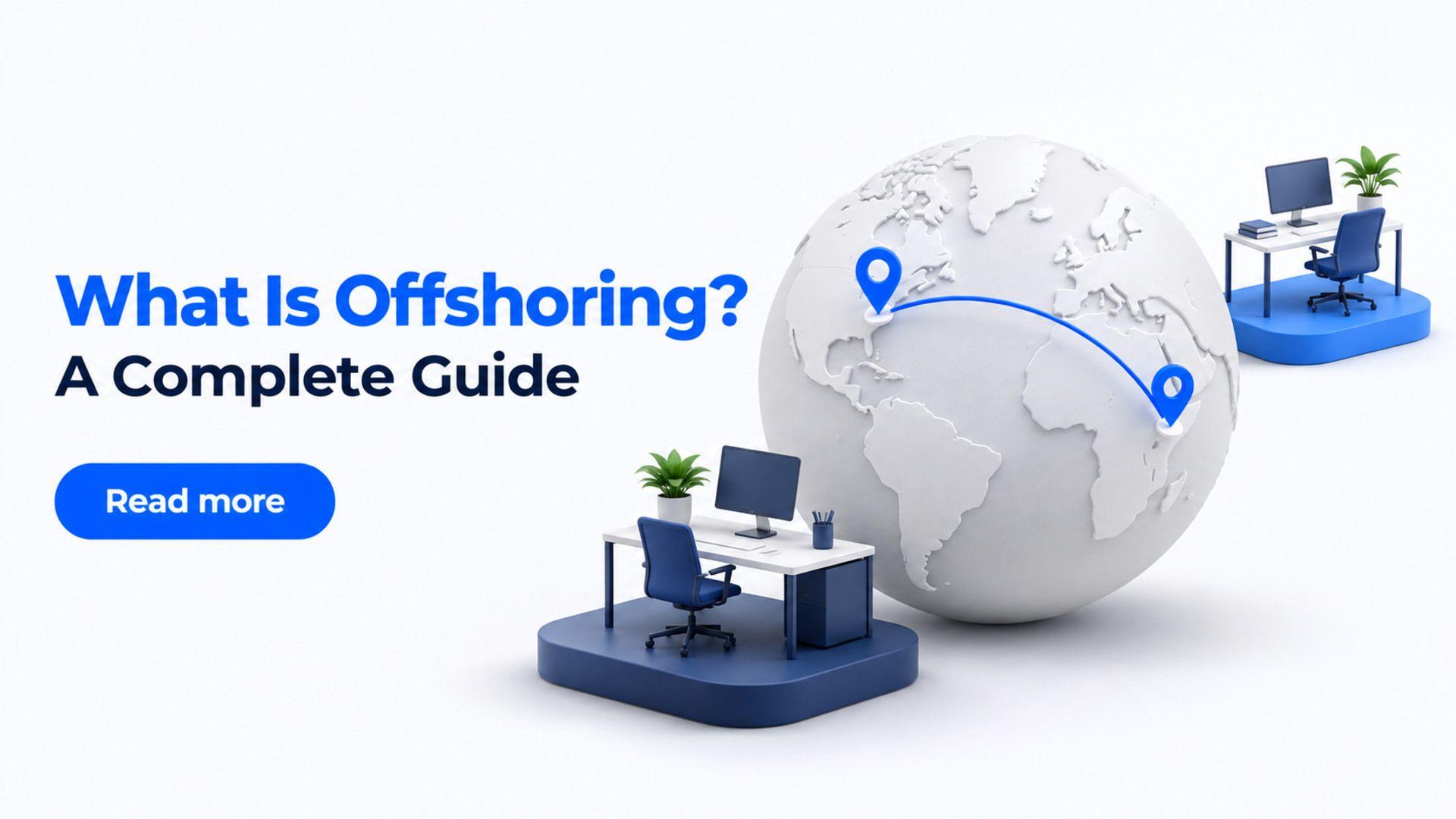
What Is Offshoring? A Complete Guide
Use genuinely relevant, high-resolution images rather than generic stock photos, and keep file names and alt text descriptive, matching the section they illustrate.
AMAmeer
November 25, 2026


Use genuinely relevant, high-resolution images rather than generic stock photos, and keep file names and alt text descriptive, matching the section they illustrate.
Offshoring shows up in business news constantly, usually tangled up with outsourcing, job losses, and trade policy debates, which makes it hard to pin down what the word actually means versus what people assume it means.
This guide separates the two: a clear definition of offshoring, how it's actually different from outsourcing, real examples of what it looks like in practice, and an honest look at both the benefits and the genuine downsides, including the job-loss question that comes up in nearly every conversation about it.
What Is Offshoring?
Offshoring is the practice of relocating a business operation or function to a different country, typically to reduce labor costs, access specialized skills, or both. It applies to manufacturing just as much as services: a factory moved to Mexico and a customer support team moved to the Philippines are both offshoring, even though one is physical production and the other isn't.
There are two main forms. In captive offshoring, a company sets up and owns its own foreign subsidiary or branch, keeping full control over operations and staff. In offshore outsourcing, the company instead contracts a third-party provider in another country to handle the work, rather than owning the operation itself.
The distinction matters because it determines who's actually managing the people doing the work, which affects everything from quality control to data security.
Offshoring vs. Outsourcing: What's the Difference?
The two terms get used interchangeably, but they describe different things. Offshoring is about location: work moves to another country. Outsourcing is about ownership: work moves to a different company, regardless of where that company is located.
Offshoring | Outsourcing | |
|---|---|---|
What changes | Where the work happens | Who does the work |
Can it be done in-house? | Yes (captive offshoring) | No, by definition |
Example | Opening your own office in India | Hiring a US-based agency to handle payroll |
The confusion comes from the fact that the two overlap constantly in practice. A US company hiring a staffing agency in the Philippines is doing both at once, offshore outsourcing, since the work is leaving the country and leaving the company.
But a US company opening its own call center in Manila is offshoring without outsourcing, since it still owns and runs the operation itself.
What Are the Four Types of Outsourcing?
Type | What It Covers |
|---|---|
Business Process Outsourcing (BPO) | Standard operational functions: customer service, HR administration, payroll, data entry |
Information Technology Outsourcing (ITO) | Software development, IT support, infrastructure management |
Knowledge Process Outsourcing (KPO) | Work requiring specialized expertise or judgment: research, analytics, legal process work |
Manufacturing Outsourcing | Physical production of goods, contracted to a third-party manufacturer |
BPO is the broadest and most common category, since it covers the kind of recurring administrative and support work that most businesses need regardless of industry. KPO sits at the other end: it requires more specialized skill, which is why it typically commands higher rates than BPO.
Real Examples of Offshoring
Manufacturing offshoring is the most visible form: a US apparel or electronics company moving factory production to a country with lower labor costs, a practice that dates back decades. Call center and customer support offshoring is probably the most familiar to consumers, with companies routing phone and chat support to the Philippines, India, or Latin America.
IT and software development offshoring sends coding, QA, and technical support work to countries like India, Poland, or Ukraine, where there's a deep talent pool of technical workers at a lower cost than hiring domestically.
And administrative and back-office offshoring covers roles like bookkeeping, data entry, and virtual assistant work, which has grown significantly as remote work has made location less of a barrier to hiring.
Why Do Companies Use Offshoring?
Cost is the most common driver: labor costs in many offshoring destinations are a fraction of equivalent US wages, which matters most for roles where the work itself doesn't depend on being physically present.
Access to talent is a close second, especially in software development and specialized technical fields, where offshoring opens up a much larger pool of qualified candidates than a local hiring market alone can provide.
Round-the-clock coverage is another factor, particularly for customer support: a team in a different time zone can keep phone and chat support staffed overnight without anyone working a night shift. And for companies scaling quickly, offshoring often lets them add headcount faster than local hiring markets, especially tight ones, would otherwise allow.
Is Offshoring Good or Bad?
It depends on who you ask, and both sides have a real point. For the business doing the offshoring, it's generally a net positive: lower costs, access to talent, and operational flexibility that's hard to replicate hiring locally alone.
For domestic workers in roles that get moved overseas, it's often a genuine loss, and dismissing that cost to make offshoring sound uniformly positive isn't honest.
The more useful framing isn't "good" or "bad" in the abstract, it's whether a specific offshoring decision is handled responsibly: whether the company is transparent about it, whether displaced workers get any transition support, and whether the offshore team is treated as a genuine extension of the business rather than the cheapest possible option regardless of quality.
Disadvantages of Offshoring
The downsides are real and worth naming directly. Communication and time zone gaps can slow down work that needs fast back-and-forth. Quality control is harder at a distance, especially early in a relationship before processes and expectations are well established.
Data security and compliance risk increases when sensitive information crosses borders into a jurisdiction with different privacy laws.
And domestically, offshoring is a legitimate driver of job displacement in certain industries and roles, even though the scale of that displacement is debated, which the next section covers directly.
How Many Jobs Have Been Lost to Offshoring?
There's no single reliable number, and that's not a dodge, it's the honest answer: neither the Bureau of Labor Statistics nor the Bureau of Economic Analysis officially tracks jobs lost specifically to offshoring, so every figure in circulation is an estimate built on different assumptions.
The estimates vary widely as a result. The Economic Policy Institute has estimated that offshoring to China accounted for a majority of US manufacturing jobs lost between 2001 and 2013.
Ball State University research puts the offshoring-specific manufacturing job loss figure much lower, around 750,000, attributing most of the remaining decline to automation rather than offshoring. Other estimates, factoring in both manufacturing and services, range from roughly 3 to 5 million jobs lost since the late 1970s.
The honest summary: offshoring has clearly cost a meaningful number of US jobs, but anyone citing one precise figure as settled fact is overstating how well this is actually measured.
Is Outsourcing Illegal in the USA?
No. There is no US federal law that bans or broadly restricts private companies from outsourcing or offshoring work. Legal analyses of the issue consistently confirm there's no overarching federal framework prohibiting it, though sector-specific rules apply in areas like banking and data privacy, and the outsourcing company remains legally responsible for how the work is performed regardless of where it happens.
Some states have passed narrower restrictions, mostly limited to government contracts, requiring that work performed under a state contract be done within the US or within the state.
Those laws generally don't reach private-sector outsourcing between two companies. Several federal bills aimed at restricting offshoring more broadly have been introduced over the years, but none has become binding law for private businesses.
When Did Offshoring Begin in the United States?
Manufacturing offshoring dates back to the 1960s and 1970s, when US factory managers began moving production, especially textiles and electronics assembly, to countries with lower labor costs. It expanded significantly through the 1980s and 1990s as trade policy and shipping logistics made overseas manufacturing more practical at scale.
Services and IT offshoring are more recent, taking off in the late 1990s and accelerating through the 2000s as internet infrastructure matured enough to make remote work genuinely viable for call centers, software development, and back-office processing.
That's the wave most people mean today when they talk about offshoring, even though manufacturing offshoring came first by several decades.
Frequently Asked Questions
What is offshoring vs. outsourcing?
Offshoring means moving work to another country, regardless of who does it. Outsourcing means moving work to a different company, regardless of where that company is. The two often overlap, but they describe different things.
Is offshoring good or bad?
It depends on the perspective. It's typically a net benefit for the business doing it, through lower costs and access to talent, but it's a real cost for domestic workers whose roles get moved overseas. Both things are true at once.
How many jobs have been lost to offshoring?
There's no official government tracking, so estimates vary widely, from around 750,000 manufacturing jobs in more conservative estimates to 3 to 5 million when accounting for both manufacturing and services since the late 1970s.
Can you give me an example of offshoring?
A US company moving its customer support operations to a call center in the Philippines, or a software company hiring developers in Eastern Europe instead of locally, are both common examples.
What are the four types of outsourcing?
Business Process Outsourcing (BPO), Information Technology Outsourcing (ITO), Knowledge Process Outsourcing (KPO), and Manufacturing Outsourcing.
What is the opposite of outsourcing?
Insourcing, bringing a function back in-house that was previously handled externally. The geographic equivalent is reshoring, moving offshored work back to the original country.
What are the disadvantages of offshoring?
Common disadvantages include communication and time zone friction, harder quality control at a distance, increased data security and compliance risk, and domestic job displacement in affected industries.
When did offshoring begin in the United States?
Manufacturing offshoring began in the 1960s and 1970s. Services and IT offshoring took off later, starting in the late 1990s and accelerating through the 2000s.
Is outsourcing illegal in the USA?
No. There's no federal law banning outsourcing or offshoring for private companies, though some states restrict it for government contracts specifically.
Why do companies use offshoring?
Mainly for lower labor costs, access to specialized talent, round-the-clock coverage across time zones, and the ability to scale headcount faster than local hiring markets allow.
Conclusion
Offshoring and outsourcing aren't the same thing, even though they're usually discussed together, and the debate over whether offshoring is good or bad doesn't have a clean answer because it genuinely benefits the business doing it while costing certain domestic workers real jobs. Understanding the mechanics, the real cost trade-offs, and the honest state of the data on job losses matters more than picking a side.
If you're considering offshoring part of your own operations, the decision usually comes down to whether the role is well-defined enough to manage remotely and whether you're set up to onboard and manage an offshore team properly.
WorkStaff360 handles that groundwork: every placement is pre-vetted, whether you need a general virtual assistant, admin support, an IT specialist, or a call center agent, so you're not building an offshore hiring process from scratch. Ready to see what offshoring your own operations could look like? Book a free discovery call to talk through what makes sense for your business.